02 / GH AXIS RESEARCH PEPTIDES

CJC-1295: research overview

A long-acting GHRH analog that sustains growth hormone and IGF-1 elevation for days — with solid early pharmacokinetics but a halted development program and no regulatory approval.

The short version

CJC-1295 is a synthetic analog of growth-hormone-releasing hormone (GHRH). It was engineered to do what the natural GHRH hormone does — signal the pituitary to release growth hormone — but to stay active far longer than the natural molecule, which is cleaved and inactivated within minutes.

It comes in two forms with very different durations. The DAC form (Drug Affinity Complex) contains a chemical arm that binds covalently to albumin, a protein that circulates in the blood for weeks. This keeps CJC-1295 active for days, elevating GH and IGF-1 substantially above baseline from a single dose [11]. The no-DAC form (sometimes called Modified GRF 1-29) has the same stabilizing amino-acid substitutions but lacks the albumin-binding arm, so it behaves as a short-acting GHRH analog.

CJC-1295 has never been approved as a drug by any regulator. Its development program was halted. The FDA reviewed it for the 503A compounding list and did not recommend it. It is prohibited in sport under WADA. Published human evidence is limited to early pharmacology studies in small cohorts. This page covers what was actually studied.

What it is

CJC-1295 is built on the first 29 residues of human growth-hormone-releasing factor, hGRF(1-29), with four amino-acid substitutions (D-Ala at position 2, Gln at 8, Ala at 15, Leu at 27) that stabilize its alpha-helical structure and block the protease cleavage that normally inactivates GHRH within minutes. In the DAC variant, a C-terminal lysine is functionalized with a maleimidopropionyl (MPA) linker that undergoes a Michael-addition reaction with the free thiol on Cys34 of circulating serum albumin, forming a covalent conjugate with albumin's multi-day circulation time. The no-DAC form keeps the four stabilizing substitutions but lacks this albumin-binding chemistry, resulting in a short plasma half-life.

CJC-1295 is classified as a GHRH analog / growth-hormone secretagogue and is sold as a research chemical for laboratory research use only. It has been identified by high-resolution LC-MS/MS in seized pharmaceutical preparations [9], which documents its presence in gray-market supply.

How it works

CJC-1295 binds the GHRH receptor (GHRHR) on anterior-pituitary somatotroph cells, activating the Gs/cAMP/PKA signaling cascade that drives synthesis and pulsatile secretion of growth hormone. Downstream, GH stimulates hepatic production of IGF-1. Because CJC-1295 acts upstream at the GHRH receptor rather than delivering exogenous GH, physiologic feedback through somatostatin and IGF-1 remains intact — pulsatile GH secretion is preserved, not replaced [12].

The DAC form's albumin-conjugation chemistry extends effective plasma half-life toward that of albumin itself (estimated 5.8–8.1 days in a human study), enabling sustained GH/IGF-1 elevation from infrequent dosing [11]. The no-DAC form lacks this pharmacokinetic advantage and behaves like a short-acting GHRH mimetic.

This mechanism is complementary to, and distinct from, ipamorelin's GHS-R1a agonism — the two receptor pathways can be activated independently or in combination [8].

What the research shows

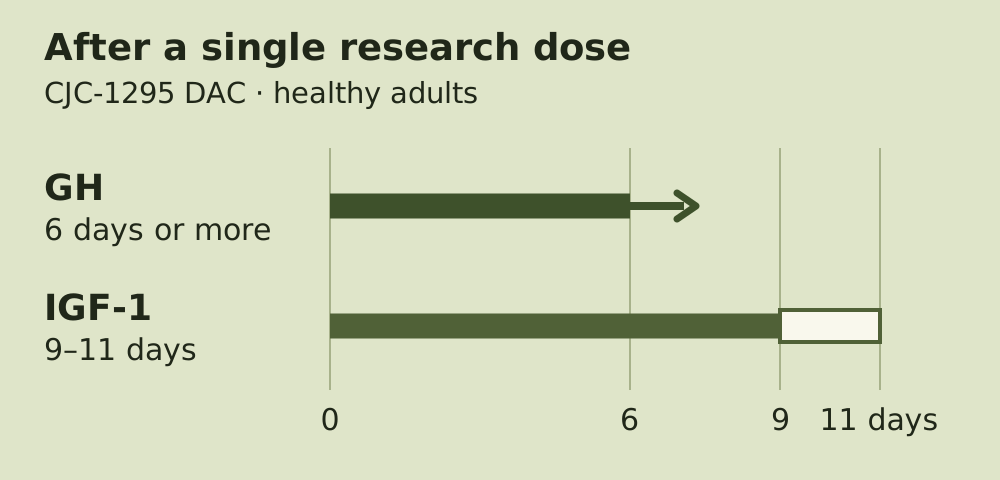
Prolonged GH/IGF-1 elevation in healthy adults (2006). The most important published CJC-1295 human study enrolled adults ages 21–61 and administered single subcutaneous doses of 30 or 60 micrograms/kg. Mean plasma GH increased 2- to 10-fold for 6 days or more; IGF-1 increased 1.5- to 3-fold for 9–11 days. After multiple doses, IGF-1 remained above baseline for up to 28 days. Estimated plasma half-life was 5.8–8.1 days. Adverse events were generally mild, most commonly injection-site reactions, flushing, and headache [11].

Preserved pulsatility (healthy men, ages 20–40, 2006). A separate study in healthy young men found that single subcutaneous doses of 60 or 90 micrograms/kg raised trough GH approximately 7.5-fold and mean GH by roughly 46%, with IGF-1 rising by roughly 45% one week later. Critically, the frequency and magnitude of natural pulsatile GH secretion were not disrupted — pulsatility was maintained under continuous GHRH-receptor stimulation [12].

Serum proteomic shifts (healthy young men, n=11, 2009). An exploratory proteomics study identified reproducible changes in the serum protein profile following CJC-1295 administration: decreased apolipoprotein A1 and a transthyretin isoform, with increased albumin fragments and immunoglobulin species that correlated linearly with IGF-1. These were candidate biomarkers of GH/IGF-1 axis activation, not efficacy endpoints [10].

Anti-doping identification (2010). CJC-1295 was unambiguously identified as the active ingredient in a seized, unlabeled pharmaceutical preparation using high-resolution LC-MS/MS — an anti-doping context that also documents the supply chain's reliability problem [9].

GHRH-analog class review (2025). A current Nature Reviews Endocrinology synthesis of GHRH and its analogs provides authoritative context for CJC-1295's pharmacology within the broader GHRH-analog class, covering receptor signaling, long-acting analog design rationale, and the therapeutic landscape [8].

Reported effects, cautions and safety

Anecdotal, not clinical evidence. The following are from research-use community reports, not from controlled clinical trials.

Frequently reported benefits: deeper and more restful sleep (the most common community report; often the first effect users notice); faster recovery from training; gradual, slow-onset fat loss especially around the midsection; a leaner or more defined appearance over weeks; occasionally improved energy or mental clarity.

Frequently reported adverse effects: water retention and puffiness — the most common downside, more pronounced with the long-acting DAC form; tingling or numbness in the fingers and hands (attributed to fluid retention on nerves); injection-site redness, itching, or swelling; occasional flushing or head-rush (more often reported with the short-acting no-DAC form near injection time); headache; and less commonly, fatigue, elevated appetite (usually attributed to ipamorelin when used in combination), or mild blood-sugar effects.

Regulatory and mechanistic cautions. CJC-1295 is not approved for human use and was not recommended for the 503A compounding list; FDA briefing materials cited immunogenicity concerns among other safety considerations for this class [8]. Sustained IGF-1 elevation is a mechanistic concern because epidemiologic data link higher circulating IGF-1 to modestly increased risk of certain cancers [8]. GH is glucose-sparing; sustained GH/IGF-1 elevation can reduce insulin sensitivity, documented for GHRH analogs in clinical studies [20]. The original CJC-1295 DAC development program was halted; the public record does not establish that a reported patient death during that era was caused by the compound, but the program never progressed to approval. The DAC and no-DAC forms are routinely confused in community and marketing contexts — they behave pharmacokinetically very differently and should not be treated as interchangeable. CJC-1295 is prohibited in sport at all times under WADA S2.

Where it fits

CJC-1295 sits at the long-acting end of the GHRH-analog spectrum on this desk. Where sermorelin is a short-acting, unmodified GHRH fragment with a historical approval, and tesamorelin is a full-length GHRH analog with a current approval in a specific clinical population, CJC-1295 occupies a middle position: pharmacokinetically sophisticated by design, with meaningful early human PK data [11][12], but without an approved indication and with a halted development history.

It is most commonly discussed in research-use communities in combination with ipamorelin, on the rationale that GHRH-receptor agonism (CJC-1295) and GHS-R1a agonism (ipamorelin) are complementary pathways [8]. No controlled human trial of this combination exists. The combination's apparent popularity outpaces its evidence base considerably.